September 1, 2026 · Johannes Brauner, Founder & Creative

From 1 September 2026, every VAT-registered business established in France has to be able to receive an electronic invoice. Not a PDF attached to an email. A structured file, delivered through an approved platform.
Two questions decide whether that means anything for you.
What matters if I work in France?
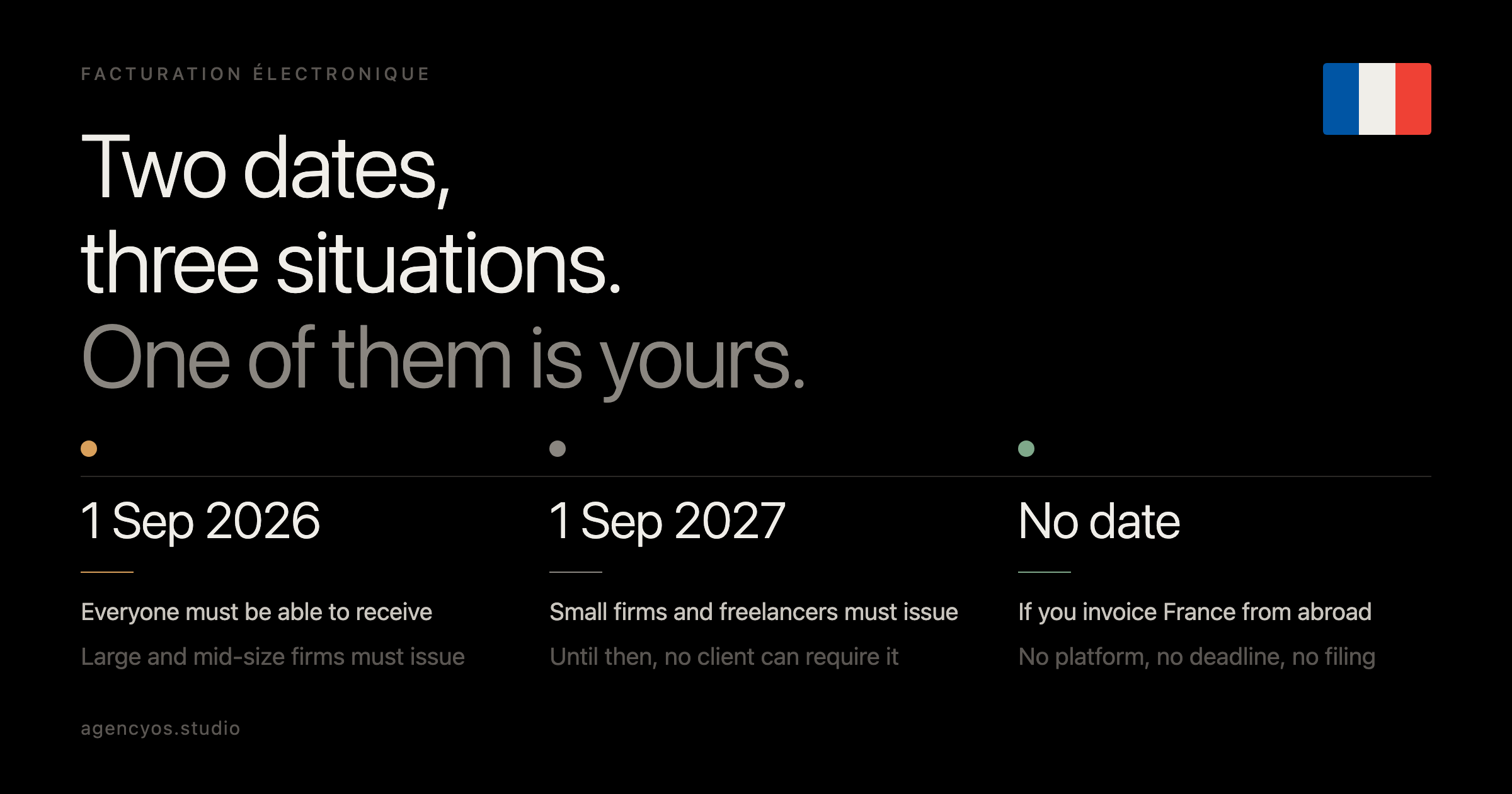
You must be able to receive e-invoices from today, which means signing up with an approved platform. You do not have to issue them until 1 September 2027 — and until then, no client can require you to.
What matters if I invoice French clients from abroad?
Nothing is legally required of you. Not in 2026, not in 2027. The law applies to businesses established in France. Your only real job is to keep your invoice easy for a French client to process.
The rest of this is the detail behind those two answers.
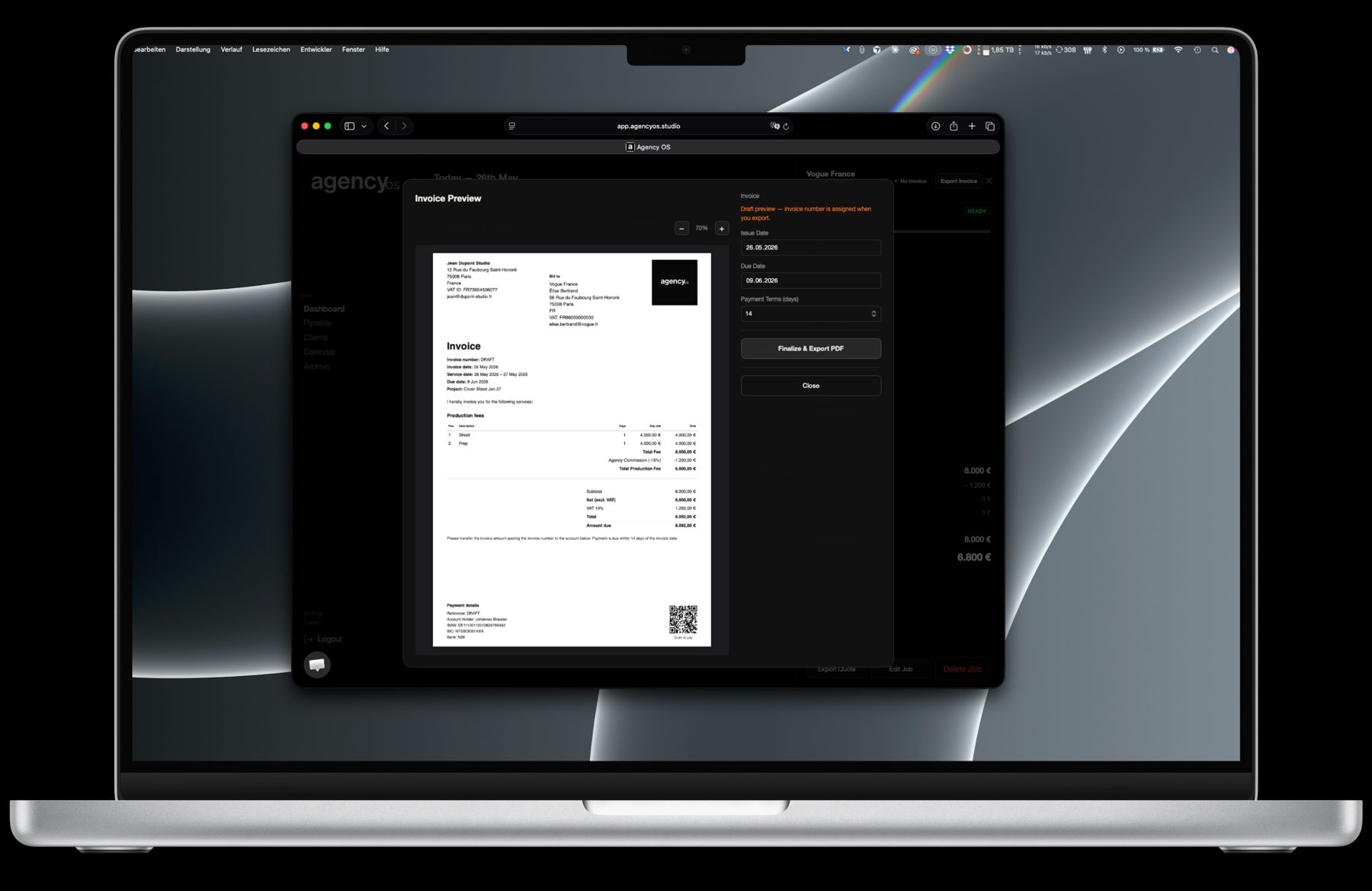
A PDF is not an electronic invoice
An electronic invoice here means a structured file — machine-readable data, not a picture of a document. France accepts three formats: Factur-X, UBL 2.1 and CII.
Factur-X is the one you will meet. It is a normal-looking PDF with the invoice data embedded inside it as XML: a human sees an invoice, a machine reads the numbers. Germany calls the same standard ZUGFeRD.
The second half matters just as much. The file has to travel through an approved platform — a plateforme agréée, still widely called a PDP. Emailing a Factur-X file does not satisfy the law. The route is part of the rule.
Which one are you?
Act today
A business established in France
You must be able to receive e-invoices from 1 September 2026 — whatever your size, franchise en base included. Pick an approved platform. Large and mid-size companies must also issue from the same day.
One year left
A French freelancer or small studio
Receiving applies to you today, so you need a platform too. Issuing starts 1 September 2027. Until then you invoice exactly as you always have, and no client can require otherwise.
Nothing due
Invoicing France from abroad
No platform, no deadline, no filing. Keep the invoice easy to process: reverse charge stated clearly, both VAT numbers, and a Factur-X or ZUGFeRD file if your tool makes one.
Three things are worth knowing beyond the boxes.
Picking a platform is smaller than it sounds. Around 150 are approved, and your accountant, your bank or your existing invoicing software very likely offers one already. You rarely need a new tool — you need to know which platform yours connects to.
A client cannot move your deadline. The tax administration's guidance is explicit: a business whose date is September 2027 may keep invoicing as before, and a client must not refuse to process or pay an invoice merely because it is not electronic. A contract can say otherwise. The law does not.
Nobody is fined for a bad first week. The administration has said it will not apply penalties automatically where start-up difficulties are real, documented and being fixed. That is not a delay — the calendar stands — but a platform outage on 3 September is not a catastrophe.
If you invoice France from abroad
You are based in Berlin, Madrid or Amsterdam, and a good client of yours is a production company in Paris. Legally, you are outside this reform: no obligation to issue, none to receive, in 2026 or 2027.
E-reporting does not catch you either. Invoicing a French client with a French VAT number means reverse charge — autoliquidation — and the reporting duty for that sits with your client, from 1 September 2027.
But your client's world changes today. Their other suppliers' invoices now arrive as structured files that reconcile themselves. Yours arrives in an inbox and needs a human to type it in. That is not a legal risk, it is friction — and it comes back as questions, delays and "please send it through our portal". The fix is not to buy a French platform. It is to be boring to process, and to send a Factur-X or ZUGFeRD file if you can. There is no downside to one.
The one real exception: if you carry out an operation located in France and you owe French VAT on it — a customer who is a private individual, or a business with no French VAT number — French e-reporting can apply to you without any establishment there. If that sounds like something you do, spend twenty minutes with a tax adviser, not with a blog post.
France is not a special case
Germany has required every business to receive structured e-invoices since 1 January 2025, with issuing phasing in from 2027. Belgium made B2B e-invoicing mandatory on 1 January 2026. Under the EU's VAT in the Digital Age package, e-invoicing to the European standard EN 16931 becomes mandatory for cross-border B2B from 1 July 2030.
France is simply the largest market to switch on so far. The good news: the XML inside a Factur-X file and the XML inside a German ZUGFeRD file are the same European norm. Get it right once and it travels.
What you have to do
This week — it starts 1 September 2026
Your business is in France? This is what you have to do:
Ask your accountant, bank or invoicing tool which approved platform they connect to — and check it against the official list.
Sign up. Your business now has an address where e-invoices can arrive — and that is the whole receiving obligation. Done.
While you are at it, check your invoices: SIREN/SIRET, both addresses, the right VAT wording — TVA non applicable, article 293B du CGI if you are in the franchise en base, autoliquidation for reverse charge.
Keep every email. If something breaks in the first weeks, proof that you started on time is exactly what the administration wants to see.
Write 1 September 2027 in your calendar. That is when you start issuing electronically — earlier if you want, voluntarily.
No deadline — nothing to sign up for
You invoice French clients from abroad? This is all you need to know:
Register nothing. There is no platform and no sign-up for you.
Put the reverse charge wording and both VAT numbers on every invoice — yours and your client’s.
If your tool can export Factur-X or ZUGFeRD, turn it on. Your French client’s system reads it natively.
A client asking you to use their portal is making a request, not stating the law. Decide like you would about any other client wish.
Sources
All of this comes from the French tax administration, not from vendors:
- Je passe à la facturation électronique — the official starting point
- Guide pratique de démarrage au 1er septembre 2026 (PDF) — what to do when things go wrong
- The official list of approved platforms
- E-reporting for businesses with no permanent establishment in France
The administration runs a free helpline for the reform: 0806 807 807. It is a French domestic number — 08 lines cannot be dialled from outside France. From abroad, the tax administration's non-resident service answers on +33 1 72 95 20 42.
This is a guide, not tax advice. If your situation is unusual — French VAT registration, sales to French consumers, an establishment in France — take it to an accountant.
Where Agency OS stands
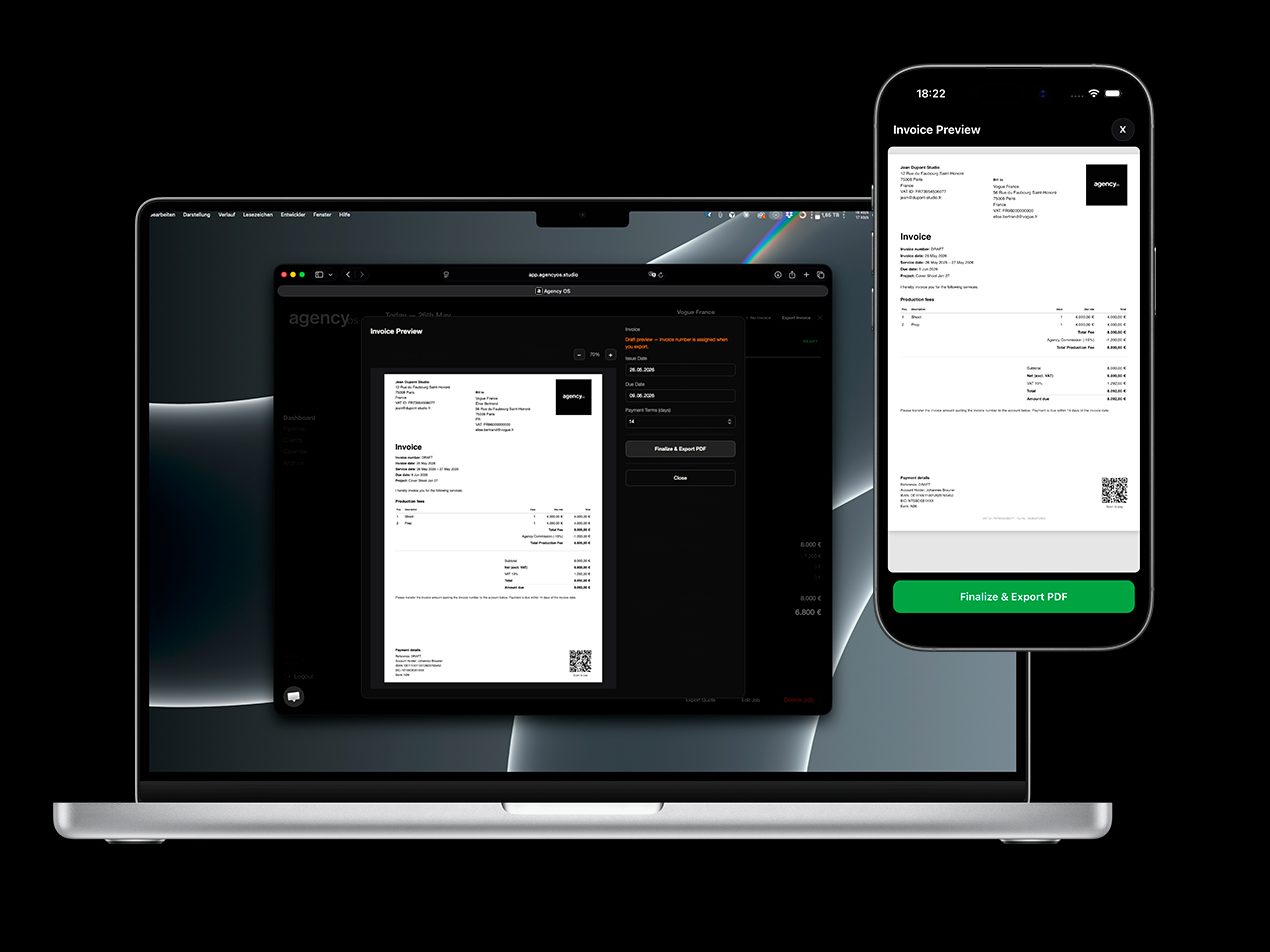
We build invoicing for freelance creatives, so we have been living inside this standard for a while. Agency OS produces ZUGFeRD invoices — the same EN 16931 XML that sits inside a French Factur-X file — so the invoice you send to Munich and the one you send to Paris carry the same structured data underneath. On the laptop and on the phone, on set, between shots.
What we support, country by country, is on our e-invoicing page — and the French rules, kept up to date, live on our France page.